AI launches usually slip because of unclear scope, unready data, integration work and thin in-house expertise, not because the model is weak. The fastest fix is to ship a narrow first version with an agile technical partner, then scale what works. The right AI development services partner removes the bottlenecks your team can't clear quickly on its own.
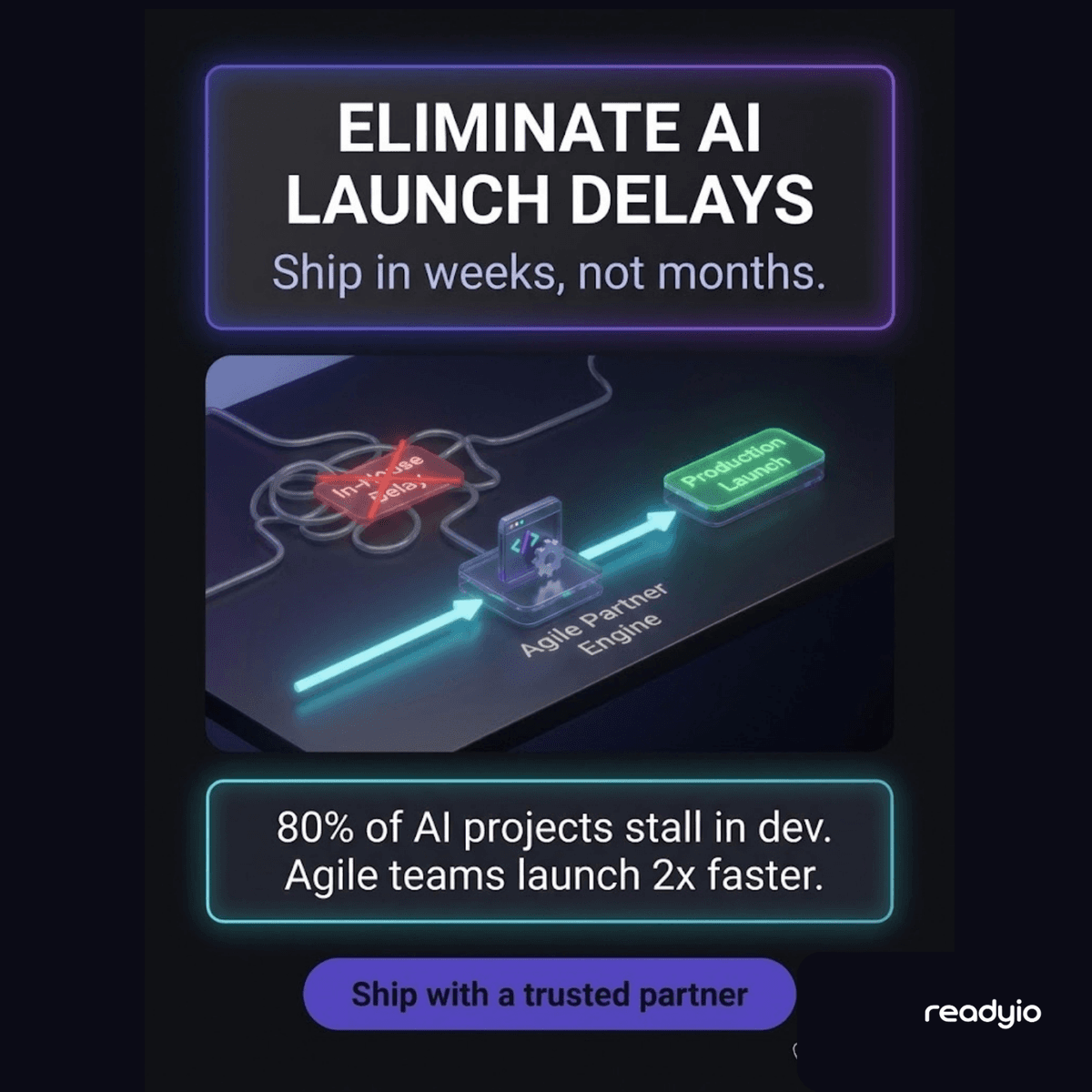
Most AI projects miss their launch window. RAND reports that more than 80% fail, and MIT found projects built with specialized partners succeeded about twice as often as internal builds. Choose AI development services that define scope early, ship in small increments, handle integration, and stay on after launch.
Key Takeaways
Delays come from process and people problems more than technical limits.
A shortage of in-house AI skills is one of the most common reasons launches slip.
Narrow first releases reach users faster than "complete" platforms.
Integration with your existing tools is where timelines quietly double.
A good partner is judged by what reaches production, not by what gets presented.
Some teams spend six months building an AI feature, then find the market has already moved.
A competitor launched a simpler version in six weeks. They have the customers, the feedback and the next release already in progress. You have a polished prototype that nobody outside the company has used.
That gap is what slow development cycles cost you. It rarely shows up as a line item, but it shows up in lost deals and in launches that land after the moment has passed.
Why AI Launches Slip
Start with the uncomfortable number. RAND interviewed 65 experienced data scientists and engineers and reported that, by some estimates, more than 80% of AI projects fail, twice the rate of IT projects that don't involve AI [1].
The part worth noticing is the cause. RAND's interviewees pointed first to leadership and communication problems. Misunderstandings about the purpose of a project were among the most common reasons for failure [1]. Teams also built around the technology instead of the end user's actual problem [1].
In other words, the model usually isn't what delays you. These are:
Vague scope. "Add AI to the product" isn't a deliverable.
Data that isn't ready. RAND lists missing training data as a leading root cause [1].
Integration work nobody planned. The model works, but it doesn't connect to your CRM, billing or workflows.
Pilots with no path to production. MIT's research found about 95% of generative AI pilots showed no measurable profit-and-loss impact, with flawed integration as a core issue [2].
No one accountable for the outcome. Work moves between teams and stalls at the handoff.
One caveat on the MIT number. It comes from a preliminary report that hasn't been peer reviewed [5]. Treat the exact percentage as a signal, not a precise measurement. The pattern, though, matches RAND's independent findings.
The Skills Gap Is a Calendar Problem
Hiring your way out sounds sensible. In practice it's slow.
Bain found that 44% of executives say a lack of in-house AI expertise is holding back generative AI adoption. It also reports that demand for AI skills has grown 21% annually since 2019, and that the shortage is likely to last through 2027. In the US, about one in two AI jobs could go unfilled by then [4].
If recruiting takes a quarter and onboarding takes another, you've lost half a year before the first sprint. That's a launch delay created before any code exists.
What an Agile Technical Partner Actually Does
"Agile" gets used loosely, so here is what it should mean in a partner relationship.
An agile technical partner:
Narrows the first release. One problem, one user group, one measurable outcome.
Ships in short cycles. You see working software every few weeks, not a big reveal at the end.
Handles the full path. Design, engineering, integration, testing and launch sit with one team, so there are fewer handoffs.
Adjusts based on real use. Feedback from live users replaces assumptions.
Stays after launch. Monitoring, fixes and improvements continue.
RAND's own advice supports the infrastructure side of this. It found that up-front investment in data governance and model deployment can substantially reduce the time AI projects take [1]. A partner who has built that groundwork before doesn't start from zero on your project.
Does Partnering Really Beat Building In-House?
MIT's data points that way. Projects that were bought from specialized vendors or built with partners succeeded about 67% of the time, while internal builds succeeded about one-third as often [2].
I'd be careful about reading that as "vendors are better." Partner-led projects may also be the ones with cleaner scope and clearer goals to begin with. The honest takeaway is narrower: when your team has not shipped this kind of system before, borrowing experience that has is a faster and lower-risk route.
Factor | Build In-House | Freelancers | Agile Technical Partner |
Time to start | Slow (hiring and onboarding) | Fast | Fast |
AI and engineering depth | Depends on hires | Varies, usually narrow | Cross-functional team |
Integration with your tools | Strong context, limited capacity | Often limited | Typically included |
Accountability | Internal, can be diluted | One individual | Single accountable team |
Scaling up or down | Slow | Hard | Flexible |
Post-launch support | Your team | Ad hoc | Structured |
Best for | Core, proprietary AI | Small, defined tasks | Getting a real product live quickly |
Building in-house still makes sense when AI is your core competitive advantage and you have the people. For most other cases, a partner shortens the path.
How to Choose AI Development Services That Ship
Ask these questions before you sign anything.
Do they define scope before they build?
A serious partner will push back on a vague brief. If they agree to everything immediately, expect surprises later.
Can they show systems in production?
Look for live products, not slide decks. Ask what changed after launch and who uses it today.
How do they handle integration?
Ask how the AI will connect to your CRM, data sources and internal tools, and who owns that work.
What does a typical release cycle look like?
You should see working increments on a predictable schedule, with clear milestones and visibility.
Are they honest about what AI shouldn't do?
Gartner expects more than 40% of agentic AI projects to be canceled by the end of 2027 because of rising costs, unclear business value or weak risk controls [3]. It also warns about "agent washing," where vendors rebrand chatbots and automation as agentic AI. Gartner estimates only about 130 of the thousands of agentic vendors are genuine [3]. A trustworthy partner will tell you when simpler automation solves the problem.
What happens after launch?
Models drift, data changes and users surprise you. Make sure monitoring and support are part of the plan.
How Readyio Approaches AI Development Services
Readyio builds websites, web applications, CRM systems and AI automation through one accountable team. That structure matters for speed, because the AI work doesn't wait on a separate vendor for the front end or the data layer.
Our approach is deliberately plain:
Understand: we define the goals, users and constraints before choosing technology.
Build: we design, engineer and test with you in close collaboration.
Launch and support: we release, then keep improving.
Two examples of how this plays out:
Freedom M&A: an enquiry system with AI callbacks, lead qualification, automated responses and workflow routing, built on voice and telephony tooling. The point was removing manual chasing between an enquiry arriving and a human responding.
Arbilo: a real-time platform that analyzes exchange data and trading pairs to surface arbitrage opportunities. Here, speed of data and a dependable dashboard mattered more than any single AI feature.
For founders, we shape the right first version, choose the technology and launch without unnecessary complexity: validate the problem, build a first version, test with real users, then keep improving.
Your Checklist: Get an AI Product to Market Faster
Name one problem. Write it in a single sentence with a measurable outcome.
Audit your data. Know what you have, where it lives and what's missing before development starts.
List integrations early. CRM, payments, support tools, internal systems.
Set a first-release boundary. Decide what is out of scope for version one.
Pick an accountable owner on your side who can make decisions quickly.
Agree on milestones and success metrics with your partner in writing.
Plan for monitoring. Decide who watches performance after launch.
Schedule the next iteration before the first release ships.
FAQs
What are AI development services?
AI development services cover planning, designing, building, integrating and maintaining AI-powered software. That can include chat and voice assistants, workflow automation, document processing, reporting and custom applications.
Why do AI projects take so long to launch?
Common causes include unclear scope, unprepared data, integration complexity, limited in-house expertise and no clear owner. RAND's research shows most of these are organizational as well as technical [1].
Is it better to hire an AI team or work with a development partner?
It depends. A partner usually gets you to market faster when you lack in-house experience. In-house teams make more sense when AI is central to your competitive advantage. MIT's research favored partnership-based approaches, though the data has limits [2][5].
How can I reduce time to market for an AI product?
Narrow the first release, prepare your data, plan integrations at the start, ship in short cycles and work with a team that has delivered similar systems.
Do I need agentic AI?
Not always. Gartner notes that many use cases labeled agentic don't require agentic implementations [3]. A simpler automation is often faster, cheaper and easier to maintain.
How long does it take to build a first version?
It depends on scope, data readiness and integrations. A good partner will give you a milestone-based estimate after a discovery conversation, not before.
Conclusion
AI launch delays are mostly preventable. They come from vague scope, unready data, integration surprises and missing expertise, and each of those can be addressed by changing how you build.
Start smaller than feels comfortable. Ship something real. Learn from actual users, then expand. And if your team doesn't have the experience in-house, bring in a partner who does.
If you'd like to talk through your project, book a free 30-minute discovery call with Readyio. We'll help you define a realistic first release and a path to launch.
References
[1] Ryseff, J., De Bruhl, B., & Newberry, S. J. (2024). The Root Causes of Failure for Artificial Intelligence Projects and How They Can Succeed: Avoiding the Anti-Patterns of AI. RAND Corporation. https://www.rand.org/pubs/research_reports/RRA2680-1.html
[2] Estrada, S. (2025, August 18). "MIT report: 95% of generative AI pilots at companies are failing." Fortune, reporting on MIT NANDA, The GenAI Divide: State of AI in Business 2025. https://fortune.com/2025/08/18/mit-report-95-percent-generative-ai-pilots-at-companies-failing-cfo/
[3] Gartner. (2025, June 25). "Gartner Predicts Over 40% of Agentic AI Projects Will Be Canceled by End of 2027." Press release. https://www.gartner.com/en/newsroom/press-releases/2025-06-25-gartner-predicts-over-40-percent-of-agentic-ai-projects-will-be-canceled-by-end-of-2027
[4] Bain & Company. (2025, March 4). "Widening talent gap threatens executives' AI ambitions." Press release. https://www.bain.com/ja/about-bain/media-center/press-releases/20252/widening-talent-gap-threatens-executives-ai-ambitions--bain--company/
[5] World Wide Technology. "A practical guide to getting AI systems into production." (Notes that the MIT report is preliminary and not peer reviewed.) https://www.wwt.com/blog/a-practical-guide-to-getting-ai-systems-into-production